















Skip to the main content.
Contact us
Do you have a complex integration challenge or need long-term stability?

We help you understand your current situation and define the next steps.
 
Business Cloud – features

Features designed for business-critical integrations

Business Cloud is built for organizations where integrations cannot fail. The platform combines powerful functionality with security and stability at every layer—from data source to receiving system.

Here’s how Business Cloud delivers control, reliability, and scalability in practice.

Features that give you control

Visual

A visual build environment with reusable components

Build and adapt integrations in a clear, structured environment. When flows are visualized instead of hidden in code, it becomes easier to collaborate, ensure quality, and evolve integrations over time.

Standard where possible. Customization where needed.

Cloud

Real-time monitoring and traceability

All integrations are monitored. You can see when they last ran, whether they succeeded, and where any issues occurred. Full traceability makes it easy to understand what’s happening—and why.

Central

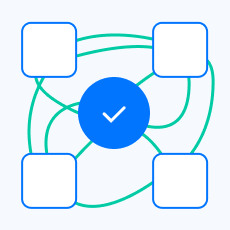
A centralized integration hub

All integrations are managed within a shared platform. This provides full visibility across your system landscape and eliminates complex point-to-point solutions. Each system integrates with Business Cloud—not with each other.

The result is an integration layer that is easy to understand, control, and evolve over time. Standard where possible. Customization where needed.

Database

Proactive error handling and data validation

Business Cloud validates data before it is passed between systems. Incomplete or incorrect information is stopped early, and the right people can be notified before it causes downstream issues.

This reduces support cases and increases trust in data across the organization.

Syncing

Version control and controlled changes

Integrations in Business Cloud are version-controlled. Once an integration is in production, it cannot be changed by mistake. New versions are created in a controlled way, allowing development and stable operations to coexist.

New versions can be rolled out automatically to all customers or gradually in a controlled manner—where changes are first tested with selected customers before being scaled.

Security—built from the ground up

Business data

Secure handling of business-critical data

Business Cloud is built to protect your data at every stage. All communication is encrypted, and each organization has isolated data storage.

Security is not an add-on—it’s a foundation.

monitored platform

A monitored and continuously updated platform

The platform is continuously updated with improvements and security patches. Both the cloud service and on-premises components are kept up to date automatically, reducing vulnerabilities and the need for manual maintenance.

Business Cloud integrates your entire system landscape—from modern cloud services to systems in local data centers—within a single platform.

Stable

Stable operations and high availability

The platform is cloud-based and built on a clustered architecture, where all core components are duplicated. If one part fails, others take over—without interrupting integrations.

Business Cloud is scaled for more than 10 million integrations per month and is designed to perform reliably even as load increases.

Regulatory compliance

Support for regulatory compliance

Business Cloud makes it easy to understand what data you have, where it resides, and how it flows between systems. This supports compliance with regulations such as GDPR and NIS2, while providing transparency across your data landscape.

Integrate all systems—regardless of where they are

Business Cloud works equally well for:

  • Cloud-based systems
  • On-premises systems
  • Hybrid environments

Regardless of where your systems run, all integrations are built on the same architecture. This allows you to connect new cloud services with existing business systems—without creating separate solutions or technical silos.

The result is a flexible integration platform that handles change—without requiring you to rebuild the foundation.

Integrations
Johan & Staffan

Who is this relevant for?

When integrations are business-critical, it’s not enough that they “just work.”

This level of stability, security, and control is essential for organizations that:

  • Have business-critical integrations that cannot afford downtime
  • Want to reduce technical debt and reliance on custom solutions
  • Deliver integrations as part of their own offering
  • Need to scale to more customers without rebuilding for each one
  • View integration as a strategic part of the business—not just a project

Boka-möte-mobil

Want to understand how Business Cloud meets your requirements for functionality and security?

See how Business Cloud is used in practice.


Want to understand how Business Cloud meets your requirements for functionality and security?

See how Business Cloud is used in practice.